Wholesale Customer Due Diligence (WCDD) Platform
@Wells Fargo
Customer Experience Design (Internal Tools, Wholesale) · 2015–2020
FARGO
I joined the WCDD program as the first full-time, staff-level designer and eventually owned end-to-end UX and UI design for the platform. Over five years, I led the evolution of UX across a highly regulated, enterprise-scale product, grew and managed a small design team, introduced design systems thinking into internal tools, and became the long-term UX owner for one of Wells Fargo's most critical compliance platforms.

Platform Context
The Wholesale Customer Due Diligence (WCDD) Platform, internally known as Cornerstone and later Case Management, was an enterprise-scale digital platform used by wholesale bankers to onboard and manage ongoing due diligence for wholesale customers across 26 lines of business.
The platform supported the full lifecycle of:
Users spanned multiple personas and system roles, including Relationship Managers, Contributors, Reviewers, Approvers, and a dedicated Investigations team, often switching roles depending on context and responsibility.
When I joined in year three of the program, the platform already existed, but UX maturity was extremely low:
The Core Problem
How to redesign a mission-critical, regulated platform without disrupting daily operations, while introducing modern UX, a scalable UI system, and shared patterns across deeply siloed business lines.
Building Trust & Understanding Constraints
Start by Building Trust, Not Disrupting Process
My initial strategy was intentionally conservative. Rather than challenging requirements out of the gate, I focused on learning the platform's domain complexity, understanding regulatory constraints, and building credibility with business analysts, engineers, and compliance partners.
I designed closely to documented requirements while quietly optimizing for performance, feasibility within IBM BPM's restrictive UI framework, and incremental UX improvements that wouldn't trigger resistance.
By aligning UX improvements with technical gains, design quickly became seen as a force multiplier, not a blocker.
Designing Through Constraint
The platform's foundation, IBM BPM, imposed extreme constraints: UI components could not be modified, pages were dynamically rendered based on user input, and a single field change could re-render an entire screen.
Early on, "page-level design" was effectively impossible. I instead focused on interaction logic, progressive disclosure, and field grouping and sequencing.
Initial Challenges
- I started as an army of one in an organization where design was not considered a required capability
- Requirements flowed directly from business teams to engineering
- Risk & Compliance was non-discretionary and could not be challenged
- IBM BPM imposed severe UI and interaction constraints
- No internal design system, UI library, or UX standards
Role Evolution & Expanded Influence
Evolving from Execution to Ownership
As trust grew, my role evolved significantly:
- I moved upstream into requirements definition
- I began influencing roadmap decisions
- I challenged assumptions, not by rejecting requirements, but by validating them through UX thinking and user feedback
Eventually, I was given full autonomy to define the end-user experience, from workflows down to component behavior, and later awarded formal ownership of UX/UI for the platform.
Lessons from early missteps: A notable miss was the initial rollout of UX personas. While the research was solid and insights were valuable, the delivery was too abstract for an engineering organization unfamiliar with design artifacts. Without sufficient education or hands-on application, personas were initially met with confusion.
Only after real user feedback validated persona-driven decisions did the broader team begin to see their value. The lesson was clear: introducing UX maturity requires meeting partners where they are, not where the discipline wants to be.
Major Transition & Design Systems
Midway through my tenure, the project shifted from incremental enhancement to a full redesign and technology migration, coinciding with:
- Adoption of a Bootstrap-based UI framework (enabling full-page layouts)
- A Wells Fargo enterprise rebrand
- Heightened regulatory scrutiny tied to AML/CDD consent orders
Introducing Design Systems Thinking
There was no precedent for branded, standardized internal tools at Wells Fargo. I initiated and led the creation of a foundational internal design system framework, reusable component patterns, and UX and interaction standards aligned to the enterprise rebrand.
Rather than enforcing adoption, I used the system as an educational and alignment tool, demonstrating how consistency, reuse, and brand cohesion improved speed, usability, and maintainability without breaking existing workflows.
Unexpected Challenges
- The sudden retirement of the product owner created a 10-month leadership vacuum, resulting in organizational chaos and shifting priorities
- High turnover among managers meant repeatedly rebuilding trust and alignment
- Ongoing tension between business and engineering organizations, each with independent authority and incentives
Results & Departure
One of the hardest challenges was persistence: outlasting organizational churn while maintaining continuity of vision. By the end, only three original team members remained, and we became recognized subject matter experts with influence well beyond our formal roles.
What Shipped
- A fully redesigned WCDD platform, aligned with Wells Fargo's enterprise rebrand
- End-to-end UX ownership across onboarding, investigations, risk, and compliance workflows
- The first internal-tools design system framework for Wholesale Banking
- A new precedent for design as an authority at the table, not just a service
Measurable Impact
Organizational Impact
- Shift from waterfall toward a hybrid agile approach
- Increased reliance on UX to clarify and accelerate requirements
- Expansion and promotion of team members
- Establishment of WCDD as foundational infrastructure for Wholesale Banking
Legacy & Lasting Impact
A year after my departure, core designs I delivered were still in use at launch. Former colleagues shared that the platform remained in good standing, UX standards persisted, and design's influence continued across the program.
Had I stayed, my next focus would have been:
- Formalizing the design system into a fully consumable library
- Scaling adoption across other internal tools
- Strengthening governance and contribution models
Reflection
This project shaped how I lead design in complex, regulated environments. It taught me that:
Influence is earned through partnership, not authority
Systems thinking is essential at enterprise scale
Persistence and rigor can outlast organizational chaos
Above all, it reinforced my belief that good UX doesn't compete with compliance or business needs. It makes them achievable.
Visual Artifacts
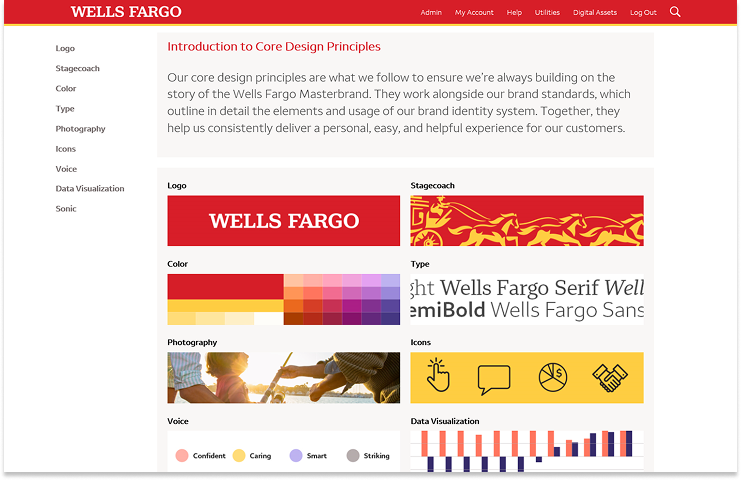
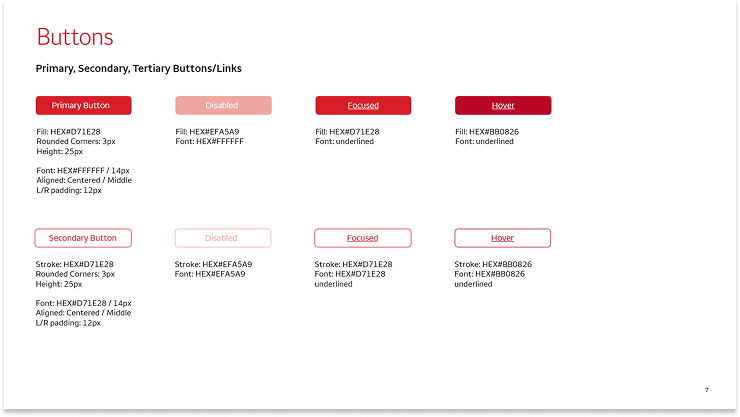
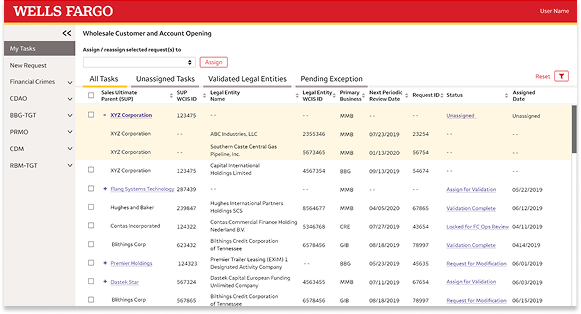
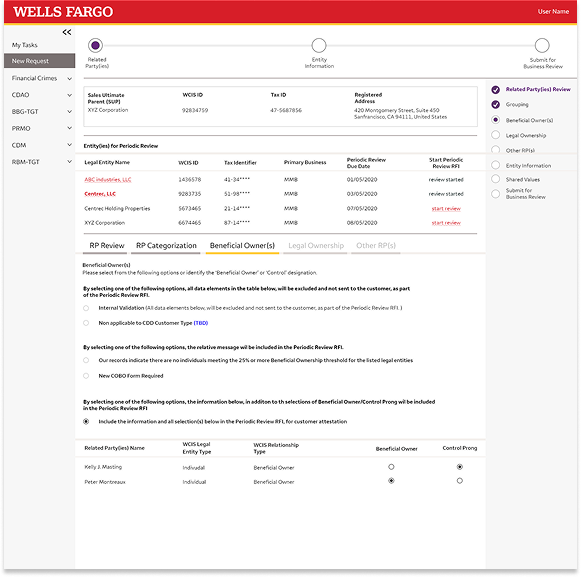
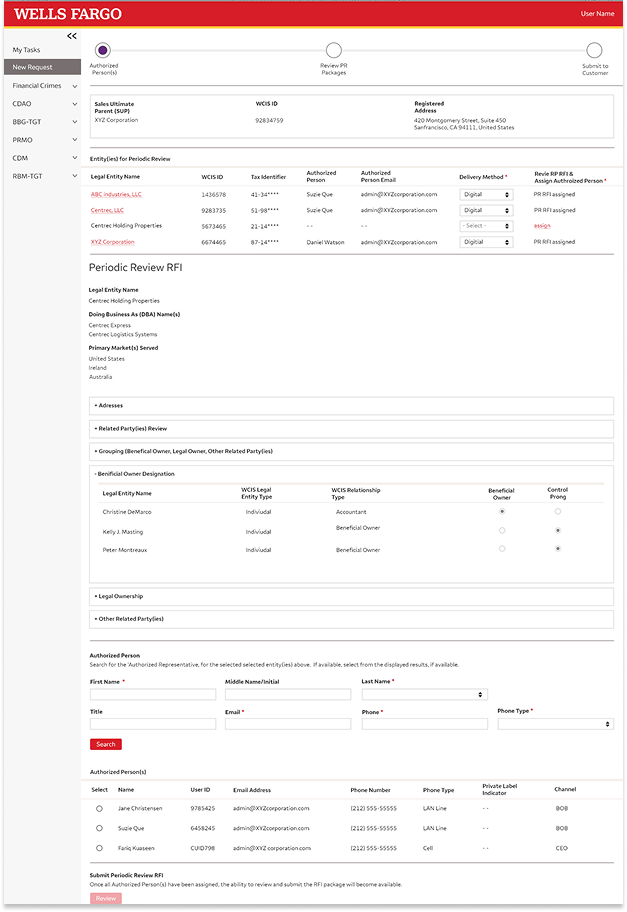
This project spanned hundreds of screens, but only a handful of visuals are shown here by design. Once core patterns, components, and interaction rules were established, most screens became consistent expressions of the same system. The examples included represent the foundational flows and patterns that defined the experience: long-form onboarding, document management (later patented), and the first application of Wells Fargo's brand to internal tools. The real work extended far beyond individual screens into systems, process, and organizational change.